More Categories

Theme images by Storman. Powered by Blogger.

Featured Posts

Sunday, December 13, 2015

American Football Rules

- No comments
tn_10_american-football-1344616591

American Football is one of the biggest North American sports. Whilst the game is played worldwide, the professional leagues in North America (such as the NFL) easily attract the best players in the world making its leagues the most competitive. The pinnacle of the sport comes in the form of the Super Bowl played out every year to millions of people around the world.

Object Of The Game


The object of American football is to score more points than your opponents in the allotted time. To do this they must move the ball down the pitch in phases of play before eventually getting the ball into the ‘end zone’ for a touchdown. This can be achieved by either throwing the ball to a teammate or running with the ball.

Each team gets 4 chances (downs) to move the ball 10 yards forward. Once they pass the 10 yards their downs reset and they start again for another 10 yards. After 4 downs have passed and they have failed to make it over the 10 yards required the ball will be turned over to the defensive team.

Players & Equipment


Whilst there are only 11 players from each team on the field at any team, an American football team is actually made up of 45 players. The teams are generally split into three groups of attacking (generally smaller, stronger, faster type of players, including a quarterback who is said to run the attacking plays and throw the ball to their teammates), defence (larger, more powerful players designed to stop players from running) and special team players (responsible for the kicking and punting side of the game with a mixture of larger and faster players).

An American football field is generally around 100 yards long and 160 yards wide. Lines are drawn on the field at 10 yard interval to indicate how far each team has to go before reaching the end zone. The end zones are added at each end of the pitch and are roughly 20 yards in length each. Posts can also be found at each end of which the kicker kicks the ball over.

Scoring


When a player scores a touchdown six points are awarded to their team. A touchdown can be scored by either carrying the ball into the end zone or receiving the ball from a pass whilst in the end zone. After a touchdown has been scored the attacking team have opportunity to kick the ball for an extra point. The ball must pass between the upright posts for a successful kick.

A field goal can be scored from anywhere on the pitch at any time (usually on the final down) and a successful kick will result in three points. A safety is where the defensive team manages to tackle an attacking opponent in their own end zone; for this the team will receive 2 points.

Winning The Game


The team with the most points at the end of the game will be deemed the winner. If the points are tied then over time will come into play where the teams will play an additional quarter until a winner is found.

Rules of American Football


  • Games last for four 15 minute quarters. A 2 minute break between the 1st & 2nd and 3rd & 4th quarters is had along with a 15 minute rest between 2nd and 3rd quarters (half time).

  • Each team has 4 downs to gain 10 or more yards. They can either throw or run the ball to make the yards. As soon as the team gains the required yards then the downs reset and the yardage resets. Failure to make the yardage after 4 downs will result in a turnover.

  • There are hundreds of different plays that players can run on any down. Plays are made up by the teams and often have players running all over the place (routes) in what is essentially organised chaos. The head coach or quarter back calls the on field plays for the attacking team whilst the defensive captain calls the plays for the defensive team.

  • At the start of every game is the coin toss to decide which team receives the ball first and which side of the pitch they want to start from.

  • The game begins with a kick-off where one team punts the ball down field for the other team to then run back with the ball as far as possible.

  • On fourth down the offence has the option to either try to make up the yards they are short or to kick the ball. If they decide to kick they have two options; to punt or to try for a field goal. Depending on their position on the pitch will usually dictate their paly. Anything within 40 yards or so of the opposition’s goal posts will result in a field goal attempt. Further back will likely mean they take the punt option.


Source by: http://www.rulesofsport.com

Aussie Rules Football Rules

- 2 comments
tn_20_aussie-rules-football-1347662657

Aussie Rules has been around since 1841 in some form or another. Its game that is pretty much exclusively played in Australia and the only professional league of its kind, the Australian Football League (AFL) is also situated there. Many players affectionate with the sport may call it a mix of footy, football, Aussie rules and Australian rules.

Object Of The Game


The object of the game is to kick the football between a series of 4 goal posts. Depending on which posts the ball goes between will depend on how many points you score. The ball can be passed around between team mates in a series of fashions and the winning team will be the team with the highest number of points at the end of the game.

Players & Equipment


Aussie rules pitches are usually played on oval sized pitches with dimensions ranging from 135 to 185 metres in length, and 110 to 155 metres in width. Many Aussie Rules pitches mix with cricket fields as they or of a similar size and proportion.

The pitches are marked around the outside to highlight the out of bounds area. At either end of the pitch 4 tall posts will be apparent. These are the scoring zones and are roughly 6 metres in height. The two front posts are 6.4 metres apart and represent the main scoring area (goal). The two post behind are also 6.4 metres apart and represent the secondary scoring area (point).

The ball is made from leather and forms an oval shape (similar to a rugby ball). Other markings on the pitch include a goal square that is 9 metres wide and spanning with width of the goals posts, centre square and centre circle.

Each team will consist of 18 players of which are all assigned to different positions. These players are allowed to move freely on the pitch. Each team may also have up to three substitutes which are ‘rolling’ meaning they can come on and off as many times as they want. Once a starting player gets substituted these players then become rolling. The positions are broken down into Full Forward, Half Forward, Centre Line, Half Back and Full Back.

There are 7 umpires for Aussie Rules in total. The three main umpires are known as filed umpires and they basically oversee all the decisions on filed such as time keeping, infringements and enforcing the rules. The two line judges are there to see if the ball goes out of play or not – these judges can also intervene where on filed umpires have missed a decision. The last two umpires are goal umpires and its their job to signal if a goal has been scored successfully or not.

Scoring


If the ball is kicked between the two goal posts (middle posts) then 6 points are awarded. If the ball goes between a goal post and one of the behind posts (point) then 1 point is awarded. 1 point is also awarded if the ball is carried or forced over the scoring line by the attacking team.

Winning The Game


The team with the highest amount of points at the end of the game are deemed the winners.

Rules of Aussie Rules Football


  • Umpires signal for all decisions and their call is final

  • By kicking the ball between the goal posts without it being touched by any other player, then 6 points are awarded. If the ball is kicked without being touched between the behind posts (point) then 1 point is scored.

  • A game consist of four 20 minute quarters.

  • The game starts with ruck. This is where the umpire throws the ball into the air and one player from each team will try and tap the ball to their team. After a goal has been scored the game will be restarted with the same way as at the beginning of the game.

  • The only way you can pass the ball is to hand ball. For this to happen the ball must be placed in the palm of the hand and then the ball struck with the butt of the other hand clenched into a fist. You cannot throw or slap the ball to perform a successful pass.

  • A player can ‘mark’ the ball when they receive it. This can happen one of three ways; the player catches the ball without the ball bouncing, the player catches the ball after it has travelled over 10 metres or the player catches the ball before it’s been touched in the air. Once marked the player cannot then be tackled. If a tackle occurs or an opponent steps over the mark then a foul will be called and the team with the ball will advance 15 metres down the field.

  • Players can tackle opponents to try and win back the ball. A player can only be tackled from shoulder height downwards.

  • If a player is tackled and refuses to let go of the ball then holding the ball will be called by the umpire and possession will be turned over.

  • Players are permitted to block their opposition by shepherding players away from the ball. This can only be done within 5 metres of the ball.

  • Players are omitted from pushing their opponents in the back either whilst they are running or whilst in a tackle.


Source by: http://www.rulesofsport.com

Football (Soccer) Rules

- No comments

tn_5_football-1344620007
Football (Soccer) is one of the oldest sports in the world and with that; it’s also one of the most recognised. The pinnacle of the international game comes in the form the Football World Cup. There are also tournament such as the Euro Championships, Copa America and the African Cup of Nations. Domestically the strongest leagues come from England (English Premier League), Spain (La Liga), Italy (Serie A) and Germany (Bundesliga). In parts of the world the sport is also known as Soccer.

Object Of The Game


The aim of football is to score more goals then your opponent in a 90 minute playing time frame. The match is split up into two halves of 45 minutes. After the first 45 minutes players will take a 15 minute rest period called half time. The second 45 minutes will resume and any time deemed fit to be added on by the referee (injury time) will be accordingly.

Players & Equipment


Each team consists of 11 players. These are made up of one goalkeeper and ten outfield players. The pitch dimensions vary from each ground but are roughly 120 yards long and 75 yards wide. On each pitch you will have a 6 yard box next to the goal mouth, an 18 yard box surrounding the 6 yard box and a centre circle. Each half of the pitch must be a mirror image of the other in terms of dimensions.

Essentially the equipment that is needed for a soccer match is pitch and a football. Additionally players can be found wearing studded football boots, shin pads and matching strips. The goalkeepers will additionally wear padded gloves as they are the only players allowed to handle the ball. Each team will have a designated captain.

Scoring


To score the ball must go into your opponent’s goal. The whole ball needs to be over the line for it to be a legitimate goal. A goal can be scored with any part of the body apart from the hand or arm up to the shoulder. The goal itself consists of a frame measuring 8 feet high and 8 yards wide.

Winning The Game


To win you have to score more goals than that of your opponents. If the scores are level after 90 minutes then the game will end as a draw apart from in cup games where the game can go to extra time and even a penalty shootout to decide the winner. Players must use their feet to kick the ball and are prohibited to use their hands apart from goalkeepers who can use any part of their body within the 18 yard box (of which more can be found out in the next section).

Rules of Football (Soccer)


  • A match consists of two 45 minutes halves with a 15 minute rest period in between.

  • Each team can have a minimum off 11 players (including 1 goalkeeper who is the only player allowed to handle the ball within the 18 yard box) and a minimum of 7 players are needed to constitute a match.

  • The field must be made of either artificial or natural grass. The size of pitches is allowed to vary but must be within 100-130 yards long and 50-100 yards wide. The pitch must also be marked with a rectangular shape around the outside showing out of bounds, two six yard boxes, two 18 yard boxes and a centre circle. A spot for a penalty placed 12 yards out of both goals and centre circle must also be visible.

  • The ball must have a circumference of 58-61cm and be of a circular shape.

  • Each team can name up to 7 substitute players. Substitutions can be made at any time of the match with each team being able to make a maximum of 3 substitutions per side. In the event of all three substitutes being made and a player having to leave the field for injury the team will be forced to play without a replacement for that player.

  • Each game must include one referee and two assistant referee’s (linesmen). It’s the job of the referee to act as time keeper and make any decisions which may need to be made such as fouls, free kicks, throw ins, penalties and added on time at the end of each half. The referee may consult the assistant referees at any time in the match regarding a decision. It’s the assistant referee’s job to spot offside’s in the match (see below), throw ins for either team and also assist the referee in all decision making processes where appropriate.

  • If the game needs to head to extra time as a result of both teams being level in a match then 30 minutes will be added in the form of two 15 minute halves after the allotted 90 minutes.

  • If teams are still level after extra time then a penalty shootout must take place.

  • The whole ball must cross the goal line for it to constitute as a goal.

  • For fouls committed a player could receive either a yellow or red card depending on the severity of the foul; this comes down to the referee’s discretion. The yellow is a warning and a red card is a dismissal of that player. Two yellow cards will equal one red. Once a player is sent off then they cannot be replaced.

  • If a ball goes out of play off an opponent in either of the side lines then it is given as a throw in. If it goes out of play off an attacking player on the base line then it is a goal kick. If it comes off a defending player it is a corner kick.


The Offside Rule in Football


Offside can be called when an attacking player is in front of the last defender when the pass is played through to them. The offside area is designed to discourage players from simply hanging around the opponent’s goal waiting for a pass. To be onside they must be placed behind the last defender when the ball is played to them. If the player is in front of that last defender then he is deemed to be offside and free kick to the defending team will be called.

A player cannot be caught offside in their own half. The goalkeeper does not count as a defender. If the ball is played backwards and the player is in front of the last defender then he is deemed to be not offside.


Source by: http://www.rulesofsport.com

England and Wales meet in historic Euro 2016 fixture

- No comments


hodgson-coleman_3525059b

England and Wales will meet at a tournament for the first time after being drawn together at next summer’s European Championship.

The third oldest international fixture will be played at a major finals 136 years after the sides first met.

England drew Wales less than five months after being paired with Scotland in World Cup qualifying for the first time. Manager Roy Hodgson told the BBC: “Whichever teams we got in that pot would have been tough; why not have a tough one close to home?"

  Photo: REX

“We know the players because all of them basically play in England. We know the team is very well organised, play well together, have fantastic team spirit and a very strong spine.” Opposite number Chris Coleman, who had wanted to avoid England, added: “England are one of the best teams so I’m thinking if we could avoid it...

“It’s fine — it will be a great game and we’ll look forward to it.” The two home nations will also play Russia and Slovakia in Group B of what will be Wales’s first appearance at a major tournament since 1958.

However, there was a familiar feeling about the venues for England’s first competitive fixtures in France since the 1998 World Cup.

Just as they did 17 years ago, they will play in Marseille, Lens and Saint-Etienne, where, respectively, they faced Tunisia, after supporters went on a rampage; Colombia, against whom David Beckham scored his first international goal; and Argentina, who won on penalties after Beckham’s red card. Roy Hodgson’s side will open against Russia in Marseille on June 11 (8pm kick-off) before taking on Wales in Lens five days later at 2pm, and finishing with Slovakia in Saint-Etienne on June 20, at 8pm. Wales open against Slovakia in Bordeaux on June 11, with a 6pm kick-off, and finish with Russia in Toulouse on June 20 at 8pm.


Hodgson will be apprehensive about facing Gareth Bale and company, despite England having not lost to Wales since 1984. But, unlike the draw for last year’s World Cup, England’s group was not terrifying enough to prompt a cut-throat gesture from Football Association chairman Greg Dyke.

Indeed, with the top two in each group and four best third-placed sides all qualifying for the new round of 16, Hodgson will have no excuses for a repeat of the debacle in Brazil.

England won 10 out of 10 matches in qualifying for the first time and Dyke said before yesterday’s draw: “I’m looking forward to the draw but I’m looking forward to the tournament even more, because we’re going to win.”

The draw for the expanded 24-team tournament contained four teams from the British Isles for the first time since 1958 and there was a 50-50 chance England would meet one of them.

Northern Ireland and the Republic of Ireland both were handed nightmare draws. In their first major tournament since 1986 and first Euros ever, Northern Ireland will face world champions Germany, Poland and Ukraine.

The Republic fared even worse, drawing Italy, Belgium and Sweden.

Source by http://www.telegraph.co.uk

10 Strangest Competitions Around The World

- No comments
Humans are competitive by nature, that’s why they enjoy each activity more by making it into a competition. There are plenty of strangest competitions out there, some of which are incredibly dangerous. But, here’s a selection of top ten out of several unusual, weirdest, Bizarre and strangest competitions around the world. After reading this top list you admit that people can compete on everything. Enjoy! this list of the top ten strangest competitions.

10 Strangest Competitions You Have To See To Believe


10. The Championship of Extreme Ironing


Championship-of-Extreme-Ironing

The first Championship on extreme ironing was held in 1997 in Leicester, Great Britain. The participants of this extreme action had to iron a couple of things in the most dangerous places – on the mountain, on the ice or in the water. The winner should not only possess skills of rock-climbing or a scuba diving, but also be able to iron shirts.

9. The Championship on Crawling


Championship on Crawling
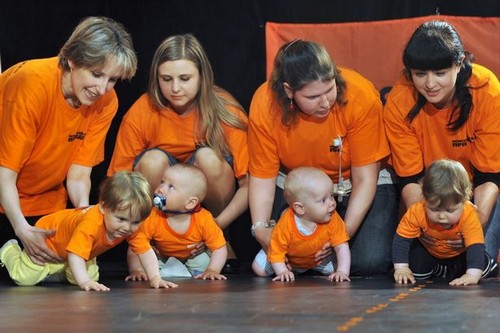
1122 children took part in the first “Marathon of Toddlers” which was held in 2005 in Colombia. Children at the age from 8 till 18 months desperately crawled on a 5-metre distance. It is not surprising that not all participants reached the end of a distance. This event was arranged by the Ministry of Health to support the sport and a healthy lifestyle.

8. Football in a Mud


Football Championship in the mud
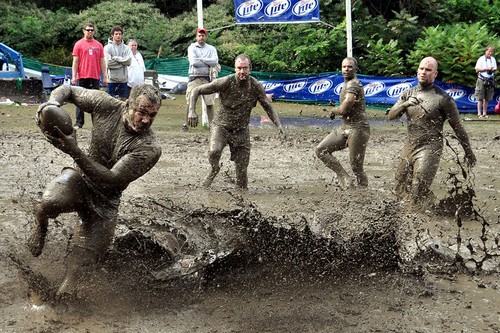
In 2008 thousand men and women there were on ankles in a mud in struggle for the main prize of the annual 10th Football Championship in the mud. This grandiose event was held in Finland, in a natural mud bog which especially for this event transformed into 22 game fields of size 60х35 meters.

Every game lasted 2 periods 25 minutes of each. In the Championship on 6 players 340 commands have taken part in everyone. Externally, the game more like a dirty carnival – sneakers and socks rewound by an adhesive tape, long dresses, white hospital gowns, supermen, tight shorts, ties, pink wigs- participants were willing to do anything to seize the main prize.

7. The Championship of Throwing Eggs


10 Strangest Competitions
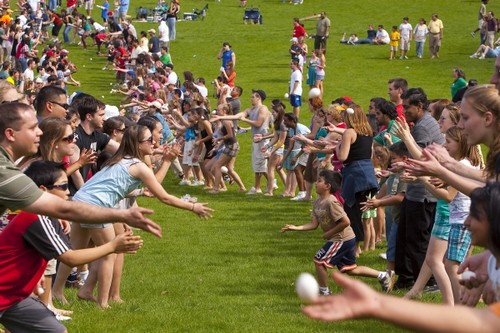
The throwing of eggs is serious sports competition which is held around the world. The championship on throwing eggs annually passes in Sutton, Great Britain, since 2006. The championship includes 4 competitive disciplines with generous cash prizes.

6. The Championship on Climbing to Palm Trees


10 Strangest Competitions
Independence Day in Indonesia is on August, 17th. This day is celebrated by traditional folk festivals, fireworks and various competitions. Climbing palm trunk – this is the hardest competition, which is attended by a team of 4 people.

To climb on absolutely smooth, oiled trunk is an uneasy problem. Some teams form a sort of ladder, clambering on each other’s shoulders. At the top of the trunk there are prizes – from towels, clothes and other practical trifles to mountain bicycles and cash certificates. The above a trunk, the more expensively a prize – such is a principle. If any team gets to the top too fast, the organizers pour water over the participants, so that they had to prove their skills again.

5. Feet Wrestling


Toe Wrestling
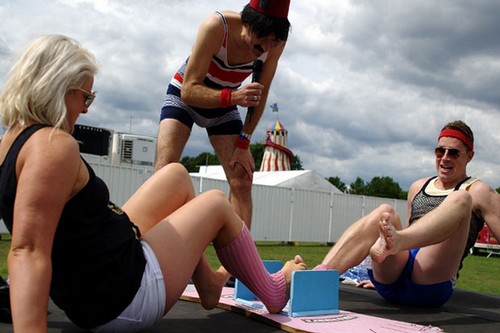
The first World championship on Feet wrestling was held in 1976 in one pub in Derbyshire, Great Britain. Participants converged with their big toes in a life and death! In 1997, the organizers even applied for the inclusion of the sport in the list of Olympic disciplines. However, this idea was not adopted. By the way, feet wrestling- is a pretty dangerous sport, which often results in sprained ankle and broken toes.

4. Championship on Inflating Hot Water Bottles


10 Strangest Competitions
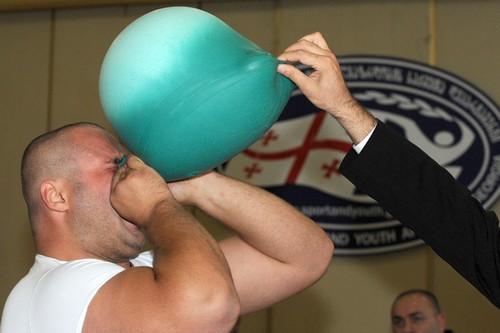
18-year-old Jamal Tkeshelashvili certainly was not joking if threatens to tear you, as a hot water bottle! After all he became the winner of the championship on inflating warmers in 2009. In total Jamal managed to burst 3 heaters: one for 23 seconds, the second – for 16 seconds and the third just in 13 seconds. He inflated one warmer with the person sitting on it! Thus, the young man from Georgia put a new world record on inflating warmers (13 seconds compared to the previous record 51.98 seconds).

3. The Championship on Whistle


10 Strangest Competitions
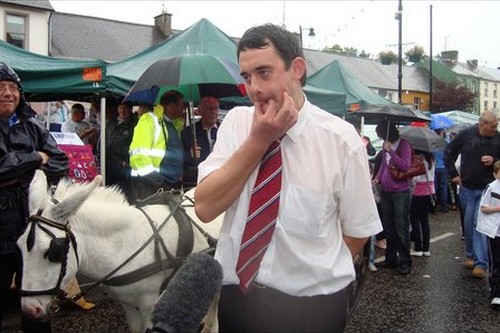
Today for whistling at seeing a pretty girl it is possible to obtain slap in the face if only you are not in small town Irvinstown. In 2009 there also held the first championship in Ireland on “the wolf” whistle. The participant who was able to express his admiration of the fair sex by means of whistles better than others received the grand prize! By the way it was the local butcher Stephen Millar.

2. Marathon on High Heels


Running a Marathon in High Heels
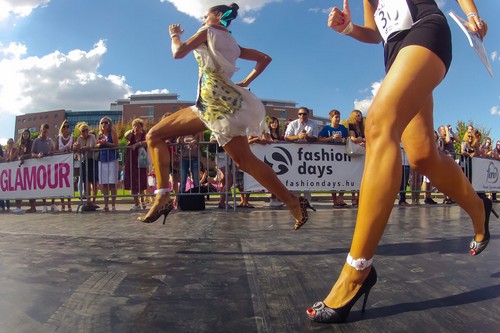
Strangest Competitions of Races on heels are held in many cities like Sydney, Paris, Amsterdam and even in Moscow. However residents of Milan were luckier than others, because they fought for a pair of elegant, luxury sandals from Manolo Blahnik itself!

300 participants of this competition had to cover a distance of 80 meters on the heels of not below than 7 cm and no thicker than 1.5 cm. All these sacrifices were worth the grand prize. By the way, at the end as many as three winners left the race in magnificent luxury sandals!

1. The Championship on Unemployment


10 Strangest Competitions
Crowds of people, who lost their workplaces as a result of an economic crisis, are not going to hide in their homes and complain about their bitter fate. On March 31st, 2009 a group of unemployed people gathered in New York to take part in the so-called Olympic Games of the Unemployed. Such idea came to mind of one programmer who was recently sent resignation. 20 Olympians took part in the competition disciplines called “Accuse the Boss”, throwing the office phones, office boxing and “You are discharged”.

Source by: http://www.wonderslist.com


Top 12 Coolest Female Mixed Martial Artists

- No comments
Over the past few year, MMA or Mixed Martial Art competition have become very popular. Like the male counterpart, there are female MMA tournaments too where some of the most incredible women fight it out to win. Here are 12 coolest female mixed martial artists:

The Coolest Female Mixed Martial Artists


12. Alexa Grasso


Alexa-Grasso

Alexa Grasso is a 22-yeras-old Mexican mixed martial artist who is currently signed with Invicta FC. She made her professional MMA debut in Mexico in 2012. She is hailed as a very powerful fighter from the beginning. In the first eighteen months, she remained undefeated with 5 wins. After a gap year, Grasso made her debut in Invicta FC in 2014 against Ashley Cummins and won.

11. Joanne Calderwood


Joanne Calderwood Female Mixed Martial Artists
Joanne Calderwood is a mixed martial artist from Scotland. In the official UFC Strawweight rankings she holds the number 7 position. One day while accompanying her brother to his class, she got introduced to Muay Thai accidently. Growing up, Calderwood moved from jobs to jobs and her training suffered until she settled on being dedicated to becoming a fighter. Professionally, she started off in 2000 and by 2009, Calderwood was named STBA Fighter of the year. Currently she competes in the Women’s Strawweight division of the Ultimate Fighting Championship.

You May Also Like;
Top 10 Coolest WWE Diva Wrestlers.
10 Most Beautiful Female Wrestlers Right Now.

10. Rose Namajunas


Rose Namajunas Female Mixed Martial Artists
Rose Namajunas is an American mixed martial artist. She ranks number 4 in the official UFC Strawweight. Namajunas has been practising Taekwondo since 5 and by the age of 16, she had learned karate and jiu-jitsu too. She attended the Milwaukee High School of the Arts and trained under Duke Roufus for kickboxing and mixed martial arts. In 2010, Namajunas debuted in MMA as an amateur martial artist. During fighting, she usually makes forward movement, kicks and jabs. She currently competes for the Women’s Strawweight division of the Ultimate Fighting Championship. Namajunas was a runner-up in The Ultimate Fighter: A Champion Will Be Crowned.

9. Valerie Letourneau


Female Mixed Martial Artists Valerie Letourneau
Valerie Letourneau is a Canadian mixed martial artist. According to UFC website, Letourneau ranks at number 9 strawweight overall. She currently competes in the Strawweight division of the Ultimate Fighting Championship (UFC). She debuted in MMA in 2007against Tannaya Hantelman and won. In November 2015, Letourneau is expected to face the current number one mixed martial artist Joanna Jędrzejczyk. So far, in total Letourneau has won 8 fights – 4 by knockout, one by submission and 3 by decision.

8. Carla Esparza


Carla Esparza Female Mixed Martial Artists
Carla Kristen Esparza is a professional mixed martial artist. According to the MMARising website, Esparza ranks 9th in pound-for-pound female MMA fighter in the world and second according to the Unified Women’s MMA Rankings. When in high school, Esparza started wrestling for the varsity team. She began participating in local and national high school wrestling competitions and won them one after the other. Seeing her talents she was given a scholarship and the opportunity to train under two-time Olympian Lee Allen. Esparza is the first UFC Women’s Strawweight Championship. Among her other accolades there is the Performance of the Night, The Ultimate Fighter 20 Tournament, the first Invicta FC Strawweight Championship and the 2013 Pan-American Jiu-Jitsu Championship Female Blue Belt Silver Medalist.

7. Livia Renata Souza


Livia Renata Souza Female Mixed Martial Artists
Livia Renata Souza is a Brazilian mixed martial artist. Currently she lies at number 6 position in the ‘fightmatrix’ website. She competes in the Strawweight division of the Invicta FC. Souza is the current Invicta FC Strawweight Champion. Souza went on to win the title in her very first fight just like her former Invicta FC Atomweight Champion and fellow Brazilian martial artist, Herica Tiburcio. In her professional mixed martial artist career, Souza has practically won every fight she has participated in, including PFC 23, XFMMA 26, PFC 24, Talent MMA Circuit 4: Itatiba 2013, Costa Combat MMA, XFMMA 9 and the Talent MMA Circuit 12: Campinas 2014.

6. DeAnna Bennett


DeAnna Bennett Female Mixed Martial Artists
DeAnna Bennett is an American mixed martial artist. In 2011, Bennett had an amateur stint at MMA and eventually made her professional debut in 2012. For the next two years, she competed for the promotion four times and won all the bouts. Then in 2014, she made her debut in Invicta FC and has since then been quiet successful at it. She won the first bout against Michelle Ould by TKO, in the second fight she faced Jennifer Maia and won unanimously. After this, in 2015, Bennett had a stand-off with Norma Rueda Center and won, once again. She currently competes in the Strawweight division.

5. Jessica Aguilar


Female Mixed Martial Artists Jessica Aguilar
Jessica Aguilar is an American mixed martial artist. Currently ranked as the third best mixed martial artist in the world, Aguilar made her professional mixed martial arts debut in 2006. In the Ultimate Fighting Championship (UFC), she made her debut against Claudia Gadelha but lost. She used to be the reigning WSOF Women’s Strawweight Champion. Previously she has also competed for Bellator Fighting Championships. Currently Aguilar is signed to the Ultimate Fighting Championship.

4. Claudia Gadelha


Female Mixed Martial Artists Claudia Gadelha
Ana Cláudia Dantas Gadelha is a Brazilian mixed martial artist and is the youngest BJJ black belt in Nova União’s history. As a child Gadelha was very rebellious and got herself involved with drugs and the wrong people. Her parents move her away. Following this one day after watching a female fighter in MMA she decided to give martial art a try. She never looked back. She made her pro MMA debut in 2008. She is three times BJJ world champion, four times BJJ Rio International Open champion, seven times Brazilian Nationals champion and she won the First Women’s Strawweight fight in UFC History.

3. Miesha Tate


Female Mixed Martial Artists Miesha Tate
Miesha Theresa Tate is a mixed martial artist from America. Tate began wrestling when she was in high school and even won a state championship. She made her professional mixed martial arts (MMA) debut in 2007. In 2009 she won her first big title in bantamweight championship of the Freestyle Cage Fighting promotion. After winning the Strikeforce Women’s Bantamweight Championship she began to be officially hailed as one of the greatest contemporary mixed martial artist. Tae also won silver in the FILA Grappling Championships.

2. Joanna Jędrzejczyk


Joanna Jędrzejczyk Female Mixed Martial Artists
Joanna Jędrzejczyk is a polish mixed martial artists who currently holds number 1 position in Fight Matrix. She came to know about Muay Thai when she was a teenager. Hoping to keep her body in shape, Jędrzejczyk began training and eventually started entering competitions. She was later trained by kickboxers Ernesto Hoost and Paul Slowinski in Muay Thai. She won the world championship six times and the European champion four times. Jędrzejczyk was signed with the Ultimate Fighting Championship (UFC) in 2014. In professional kickboxing Jędrzejczyk holds a record of 27 wins and 2 losses and a record of 37 wins against 3 losses in amateur kickboxing.

1. Ronda Rousey


Ronda Rousey The Expendables 3
Ronda Jean Rousey is a mixed martial artist from America. Having won all twelve professional fights, she is the current reigning undefeated in mixed martial artist. Rousey is the first and reigning UFC Women’s Bantamweight Champion. She is also the Strikeforce Women’s Bantamweight Champion. In the 2008 Summer Olympics Rousey became the first American woman to win an Olympic medal in Judo. Currently she hold the number one position in the 50

Source by: http://www.wonderslist.com

Saturday, December 12, 2015

Twitter Sics Promoted Tweets on Logged-Out Users

- No comments
xl-2015-twitter-1

Twitter on Thursday revealed it's testing the expansion of promoted tweets aimed at logged-out users.


The company has been searching for ways to monetize the patronage of the roughly 500 million logged-out users per month who hop off Google for a moment to read tweet or two. The glue here is more tweets, more content.

The test will enable logged-out users to view promoted tweets and allow organizations to continue using their same marketing techniques.

If the experiment goes as planned, the expanded reach will enable marketers to "tap into the total Twitter audience" and reach more people using the same targeting, advertising and measurement tools, said Deepak Rao, Twitter's revenue product manager.

The move will provide marketers with a new channel, said Justin Hamel, CEO ofMastaMinds.

"In the past, what we have seen with new advertising channels is the prices will be very cheap -- that will make it very attractive to advertisers," he told the E-Commerce Times. "Having the ability to target non-logged-in Twitter users provides a new demographic to laser target ads to."

Know the Audience


While it will open up a new channel for marketers, Twitter may not understand enough about its logged-out users, or else the number wouldn't have climbed to 500 million per month, according to Elizabeth Lampert, president ofElizabeth Lampert PR.

"There are a number of impressions that need to be made to activate the purchase," she told the E-Commerce Times.

"That said, Twitter does have the advantage of knowing a lot about the user based on the information they share, they follow and tweets they favorite. Knowing and understanding are necessary for monetization, and I think they may have a long way to go," Lampert added.

For logged-in visitors, this might not be the greatest thing in the world, according to Hamel.

"Nobody wants to see more ads," he said. "Not to mention finding the relevant info is going to be harder now for them because they will have to sift through more ads and tweets."

For marketers, the downside is that this wider audience includes even more unknowns. Simply put, it's easier to serve regulars than to cater to out-of-towners.

On the Money


Though it's still just a test, and Twitter has scrapped loads of experiments, the move should at least encourage investors, Hamel said.

"Twitter stockholders, stand up and applaud. This strategic move will surely increase Twitter's revenue and profits. It will also give non-signed-up users a swift kick in the caboose to actually take action and create a Twitter account, since creating an account will get rid of some of the spammy ads," he said.

While promoting content to outsiders may be new to Twitter, it's a common practice among forum sites across the Internet, said MastaMind's Hamel.

"It kills two birds with one stone: maximizes profit and increases user signup," he said. "If I was running Twitter.com, I would have done this many moons ago."

Source by: http://www.technewsworld.com